

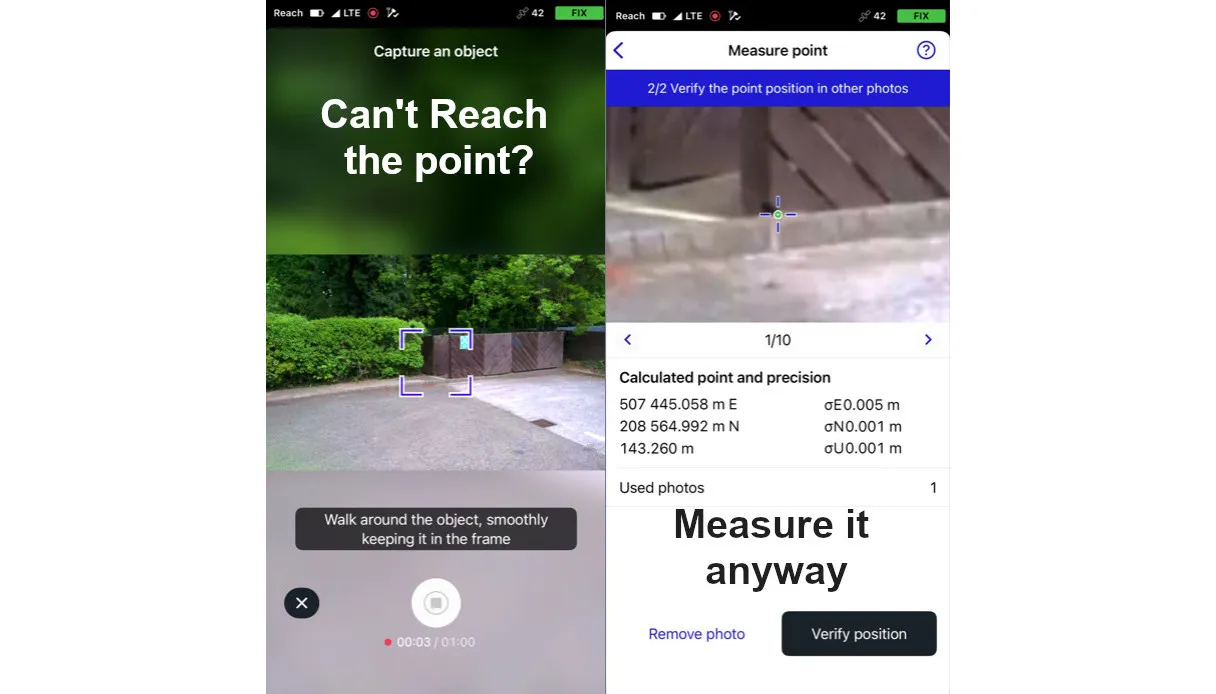
A Changing Approach to Hard-to-Reach Survey Points
Surveying inaccessible points has always been a common challenge on site.
Whether it’s:
- Behind fences
- Across busy roads
- On building facades
- Or within hazardous or restricted areas
These scenarios often interrupt otherwise straightforward workflows.
Traditionally, capturing these points requires switching methods — typically using a total station, offsets, or indirect measurement techniques. While effective, these approaches introduce added complexity in the field, including additional setup time, equipment changes, and workflow disruption.
A Shift in Workflow with Visual GNSS
Recent developments in GNSS technology are beginning to change how these situations are handled.
With the integration of cameras and visual positioning, it is now possible to capture points remotely without physically occupying them.
Instead of moving equipment or changing methods, surveyors can:
- Capture imagery safely from a distance
- Select measurement points directly on screen
- Generate survey-grade coordinates in real time
This combines GNSS with visual positioning techniques, reducing the need for secondary setups and simplifying the overall process.
What This Means on Site
The impact on field workflows is significant.
Surveyors no longer need to:
- Enter hazardous or restricted areas
- Set up additional instruments for isolated points
- Interrupt primary GNSS workflows
In many cases, points that would previously require a separate setup can now be captured as part of the same pass.
This approach also makes it possible to measure features such as facades or objects behind obstacles directly from captured imagery.
Key Benefits
- Improved safety by reducing exposure to traffic and difficult terrain
- Simplified workflows with less reliance on multiple instruments
- Faster data capture through fewer setups and repositioning
- Greater accessibility to points that were previously difficult or impractical to measure
Where It Has the Greatest Impact
This approach delivers the most value in environments where access is constrained or conditions are complex, including:
- Urban sites with obstacles and limited visibility
- Road and infrastructure projects
- Confined or high-risk areas
- Time-sensitive projects requiring efficient data capture
In these scenarios, traditional methods often introduce delays that modern GNSS workflows can avoid.
A Broader Shift in Surveying Practice
This development represents more than just a technical improvement.
It reflects a shift in mindset from:
“How do I physically access this point?”
to:
“How can I capture this point efficiently from where I am?”
Reducing the need for physical access removes friction from the workflow and allows survey teams to work more flexibly, particularly on complex or constrained sites.
Is It Worth Adopting?
For straightforward, open sites, traditional methods remain effective.
However, where access is limited or site conditions are complex, GNSS with visual positioning offers clear advantages — not only in speed, but also in safety and operational simplicity.
Find Out More
For teams looking to streamline workflows and improve how inaccessible points are captured on site:
👉 Contact Innovelec to explore how these technologies can be applied in practice.
About the Author
Graeme Woodall is a GNSS and geospatial product manager with over 18 years’ experience in RTK positioning, 3D capture, and survey workflows. He focuses on practical applications and real-world use of positioning technology.